






Journalism Research News on a summer break
The Journalism Research News staff will be taking a well-deserved summer break. Updates will be on hiatus beginning July 7th. Regular activities will resume in mid-August. During this break our … Continued
Journalists’ Perceptions of Ownership Change and its Impact on Journalistic Content and Work
Journalism Research News on a summer break
The Journalism Research News staff will be taking a well-deserved summer break. Updates will be on hiatus beginning July 7th. Regular activities will resume in mid-August. During this break our … Continued
ARTICLE: What’s keeping newspapers from fully engaging social media?
Mainstream newspapers in Finland, Japan and Korea have one thing in common: they all seem to under-utilize social media in their operation. The reasons, however, are different for each country, … Continued
On week 27 the following publications have come to our attention: Collaborative Production in the Creative Industries Edited by James Graham and Alessandro Gandini Published by University of Westminster Press … Continued
CFP | 31.8. | Media and politics in the “pop-democracy”
The annual conference of the Italian Association of Political Communication is calling for paper proposals. The conference is to take place in Rome, Italy, between the 14th and 16th of … Continued
ARTICLE: Fractured news reading on smartphones is supplemented by other platforms
A commonly cited truism is that smartphones are fracturing news reading into fast, intermittent spates of attention – so-called “snacking” or “grazing” on news. But is this really the case, … Continued
ARTICLE: China is a difficult media market for Western news organizations
China is the largest Internet market in the world. How do Western news outlets operate there with their Chinese-language online editions? Hsiang Iris Chyi, of the University of Texas at … Continued
ARTICLE: Why do journalists rely on unverified sources?
How do journalists decide which distant sources they can use, asks Florian Wintterlin, of University of Muenster. Wintterlin interviewed 12 German journalists, whose work often involves using distant sources, such … Continued
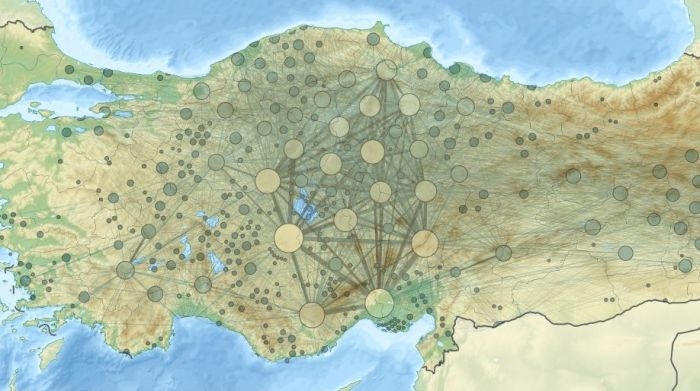
ARTICLE: Turkey’s news media landscape highly polarized also on Twitter
Twitter has become an important playground for the news media in Turkey. Burak Doğu of the İzmir University of Economics, conducted a network analysis in Twitter to look at Turkey’s … Continued
CFP | 31.10. | Society for Phenomenology and Media conference
The Society for Phenomenology and Media’s 20th Annual Conference “Global Media Literacy in the Digital Age” is calling for papers. The aim of this conference is to explore various dimensions … Continued
Here is a list of all academic peer-reviewed articles, reports and other papers published in July 2017 about journalism research. The list is updated a couple of times per week. … Continued
ARTICLE: Truthmeter helps journalists evaluate credibility of Twitter contributors
How can algorithms help journalists judge the credibility of sources? Richard Fletcher, of the University of Oxford, Steve Schifferes, of City University London, and Neil Thurman, of Ludwig Maximilians University … Continued
ARTICLE: Fake news do not set the news agenda – but neither do fact-checkers
How much influence do the so-called fake news have on the overall news agenda? The question was researched by Chris J. Vargo, of University of Colorado, and Lei Guo and … Continued
ARTICLE: Competencies of a good interviewer
Serena Carpenter, Anthony Cepak & Zhao Peng, all of Michigan State University, investigated the rarely studied topic of interviewing. Researchers interviewed nine experienced journalists and eleven journalism educators in the … Continued
ARTICLE: Different types of government support could help foster diversity in South African media
There should be more constructive debate about media diversity in South Africa, Julia Plessing of the University of Johannesburg, argues. She studied different types of print media regulation and support … Continued
ARTICLE: Self-selected media seems less biased than media in general
If the audience is increasingly able to select the news sources they follow, how come so many still perceive the media as biased? An American team of researchers investigated the … Continued
ARTICLE: How do Chinese journalists navigate censorship?
The professional freedom of Chinese journalists is constrained by the state apparatus, but not entirely quenched by it. What tactics do the journalists use in order to gain access to, … Continued
ARTICLE: American journalists conflicted by mass shooting coverage
American journalists are largely satisfied by the way mass shootings are covered, while they still see room for improvement. The journalists’ attitudes were studied by Nicole Smith Dahmen and Jesse … Continued
Ethnographic research on Turkish media: a case study of journalistic ethics in a polarized society
Written by Ozan Aşık, Uludag University Ethnographers immerse themselves in the social world of a relatively small community and observe from the inside “how people lead their lives, how they … Continued
ARTICLE: Which social media posts by newsrooms gather most likes and comments?
Which types of social media posts gather most interaction from the audience? Are there differences between newsrooms and social media platforms? Anders Olof Larsson, of Westerdals Oslo School of Arts, … Continued
On week 26 the following publications have come to our attention: Present Scenarios of Media Production and Engagement Edited by Simone Tosoni and others Published by edition lumière 300 pages … Continued
ARTICLE: Skeptic post-Millenials like opinionated journalists, but don’t trust them
How does the post-Millenial generation assess the Twitter behaviour of journalists compared to celebrities and opinionators? Jasun Carr, of Idaho State University, and Mitchell Bard, of Iona College, conducted an … Continued
CFP | 10.8. | Safety of journalists covering conflict and sensitive issues
Oslo and Akershus University College will arrange a two-day conference 2 and 3 of November 2017, in connection with UNESCO’s International Day to End Impunity for Crimes against Journalists. The … Continued
ARTICLE: Little difference between liberal and conservative papers’ coverage of the Crimean crisis
American newspapers covered the 2014 Crimean crisis in a fairly uniform fashion regardless of the papers’ political orientation, writes Anastasia N. Sorokina, of Temple University. Sorokina analysed 568 news article … Continued
ARTICLE: Performance of journalistic roles affects objectivity of reporting
Comparative research on journalistic objectivity has most often been studied in Western contexts. Claudia Mellado, of Pontificia Universidad Católica de Valparaiso, María Luisa Humanes, of Rey Juan Carlos University, and … Continued
ARTICLE: Partisanship can help news media literacy
What kind of people are more likely to develop their news media literacy (NML) skills, ask Melissa Tully, of University of Iowa, and Emily K. Vraga, of George Mason University. … Continued
ARTICLE: Pedagogical newsrooms teach content production and help to gain deeper understanding
Pedagogical newsrooms have a dual function: content production and reflective learning. Maarit Jaakkola, of the University of Tampere, studied six curriculum-related newsrooms in the Nordic countries: Utain, Smocka, Västfronten, NetAvisen, … Continued
Readers associate innovation with unique or alternative ways of doing journalism, not necessarily with just technology. A research by Summer Harlow, of Florida State University, looked at audience motivations of … Continued
ARTICLE: Two takes on immigration at the Morocco–Spain border
Francesca Di Renzo, of University of Sheffield, has studied the way two Spanish news outlets covered immigration at the Morocco-Spain border. The city of Melilla, especially, is a site where … Continued
ARTICLE: The construction of balance in TV coverage of UK EU referendum
Impartiality of news during political campaining should mean more than just balancing opposing sides. Stephen Cushion and Justin Lewis, of Cardiff University, studied how impartiality was editorially constructed and interpreted … Continued
ARTICLE: Chinese and Western representations of smog in Beijing
Chinese and Anglo-American media represent Beijing’s smog problem very differently, write Ming Liu, of Sun Yat-sen University, and Chaoyuan Li, of Xi’an International Studies University. The authors algorithmically analysed 1 … Continued