





This article dealing with identity, memory, and proximity and their effect on reporting in the context of Cameroon and Nigeria was written by Edwin Nfor from University of Jyväskylä and Silas Udenze from University of Toronto. Edwin Nfor has also written for JRN, for example here, when he was still a doctoral student.
Journalists covering crises often face the challenging task of providing balanced reports, as their interests and identities may influence how they report. This study juxtaposes the Anglophone crisis in Cameroon with the older Biafran Civil War in Nigeria. The events were chosen on theoretical grounds: proximity and memory.
Both of the conflicts are deeply intertwined in the issues of ethnic identity, historical trauma, and regional marginalization. The Anglophone crisis started in 2016, while the Biafra case occurred during the Nigerian Civil War (1967-1970).
The authors were conscious of the limitation to reporting in the cases where the state is directly involved in, or perceived to be, the source of oppression. Also, as noted by Höglund and Schaffer (2021), journalists are always expected to play a role in facilitating lasting solutions. The audience may, however, question the journalists’ ability to be balanced, when the proximity and journalistic identity interact.
The research question, then, was “How do personal experience, ethnic identities, and geographic proximities of journalists in these regions shape their coverage and reporting of crises?” And the article contributed to the understanding of the intersection of identity, journalism, collective memory, and conflict reporting in ethnically charged and politically sensitive environments.
To gather data, the authors interviewed and thematically qualitatively analysed the interview transcripts. There were 10 Anglophone journalists from Cameroon and 10 journalists from Southern Nigeria. The Cameroon sample included both male and female journalists, both from public and private media, from the cities Douala and Yaoundé. They also had family connections to the Anglophone region. The Southeastern Nigerian journalists were all Igbos, from and reside in Anambra, Enugu, and Ebonyi States of Nigeria, and indigenous.
Both groups of journalists told the authors that their ethnic identities deeply influenced the understanding and engagement with the conflicts. The Nigerian journalists also expressed a cultural connection to the crises in the region. In Cameroon, the ethnic/linguistic identity shaped the perception and framing of the conflict.
Their connection clashed with the expectations of neutrality or the promotion of a unified national identity. However, they frequently adopted a role as “the voice of the people” by telling the truth. Nevertheless, the loyalties created ethical dilemmas. Historical memory among the journalists was not just a passive repository, but an active one that shaped their professional ethos.
Geographic proximity also played a crucial role in shaping their perspectives and the content of reports. The interviews revealed that geographic proximity had a significant influence on how news are reported. Anglophone journalists in conflict regions included more first-hand experiences. In Nigeria, while the experiences were in the past, they still felt a close connection to the conflict due to ties to the region.
The authors argue that geographic proximity and the mnemonic ties with a certain region are interpretative tools that help journalists to contextualize the issues to the broader context of historical conflicts. Physical distance might limit immediate access, but the linguistic and ethnic proximity urges them to leverage this to their advantage. Indeed, being based on other regions has distinct advantages from physical safety to access to diverse sources.
For the field of crisis reporting, this article advances scholarship by theorizing proximity as a mnemonic condition. Closeness shapes what is remembered, archived, or rendered ephemeral in news production. The implications can have an effect on journalism policy and training.
The lens of memory is new to this field, even as proximity is already covered in previous studies on crises (Mollerup and Mortensen 2018; Thompson 2019). Just like Anglophone journalists residing in the regions are able to report with more facts and details, so are Nigerian journalist located in Southeast.
The article “The hidden toll and mnemonic cost of crisis reporting: Journalists’ memory, identity, ethnicity and geographic proximity” by Edwin Nfor and Silas Udenze is in Journalism. (Open access).
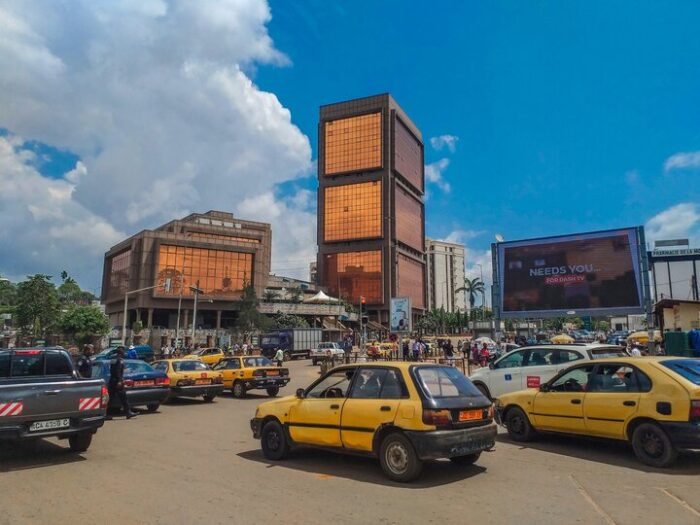
Picture: image of road traffic at the “poste centrale” crossroads in Yaounde, Cameroon
By Ariel Nathan ADA MBITA
License Unsplash.