




The study “Generative Visual AI in News Organizations: Challenges, Opportunities, Perceptions, and Policies” by T.J. Thomson from RMIT University in Melbourne, Ryan J. Thomas from Washington State University, and Phoebe Matich from Queensland University of Technology looked at how photo editors and the like perceive the use of generative visual AI in editorial operations in seven countries.
Leading newsrooms have started employing and hiring specialists in AI imagery to use the new technology responsibly, but the topic is still fraught with legal and ethical challenges. It still remains to be seen how generative AI will be used in news, and this study fills the gap in understanding the issue by interviewing visual editors.
Astrid Gynnild (2019) defines visual journalism as “the narrative elements of storytelling that can be seen or watched”. Further, the use of AI adds a tension between the objectivity of photorealism and the subjectivity of image use and can parallel misinformation, as AI images may present things that have not happened or people that do not exist (Ciammaichella 2023).
Photo editors or the equivalent were interviewed in seven countries about the perception and the use of generative visual AI. The countries were Australia, France, Germany, Norway, Switzerland, the United Kingdom, and the United States of America – all Western, First-World countries. There were 20 participants from 16 organizations and the interviews were 30 to 90 minutes in length. They were conducted in March to November 2023. The interviews were then transcribed by AI and coded.
Seventeen of the editors had used text-to-image generators before, and only three had not. Midjourney and DALL-E were the most popular generators. The participants were astonished by the growth and refinement of the tools in the span of just a few months, but some reported being unsatisfied with the results, having to refine the prompts or use photoshop. However, they largely had a positive perception of the AI tools.
The use of generative visual AI in journalism was regarded as being ethically challenging, concerning, and risky, especially as a replacement for photojournalism. Many had the opinion that AI images don’t belong and are not welcome in news coverage. Nevertheless, they urged against blank condemnation of the tools but emphasized the need for caution in their use.
The participants identified 15 challenges related to text-to-image generators. The main 5 challenges were mis/disinformation, labor displacement, copyright issues, detection difficulties, and algorithmic bias and reputational risk. An additional 10 risks were identified, relating to both the difficulties in getting staff to be comfortable with the tools and the impact of the images themselves, such as legal troubles.
In addition to the challenges, the participants identified 12 opportunities granted by the tools. For example, AI was good for creating illustrations that were not photorealistic, it could be used for brainstorming and ideation, and additionally, some saw not using AI as an opportunity to distinguish the news outlet from the ones that use it. Eight additional opportunities were mentioned.
Some outlets – six out of sixteen – had policies regarding the use of generative visual AI. Five banned the use of generating AI images (three restricted this ban to photorealistic images only), while four had formal policy that allowed the publication of AI images if the story is about AI-generated images.
Two outlets would not use AI to replace wire service imagery. Two had a policy to not use generative fill with photos. In one, AI could be used for data visualizations. Further, one allowed journalists to illustrate a story about AI with AI images while another forbade staff from using third-party generative visual AI. Clearly, the policy is evolving in newsrooms.
In conclusion, the interviews presented a varied picture on the challenges and opportunities. Regarding labor displacement, illustrators and graphic designers were most in danger, while photojournalism seems to be relatively safe. However, the use of AI-generated images may displace the use of stock photography somewhat.
As a limitation and venue for additional studies, other countries should be studied and other forms of visual AI than text-to-image generative visual AI could be studied, such as automating layout and such.
The article “Generative Visual AI in News Organizations: Challenges, Opportunities, Perceptions, and Policies” by T.J. Thomson, Ryan J. Thomas, and Phoebe Matich is in Digital Journalism. (open access).
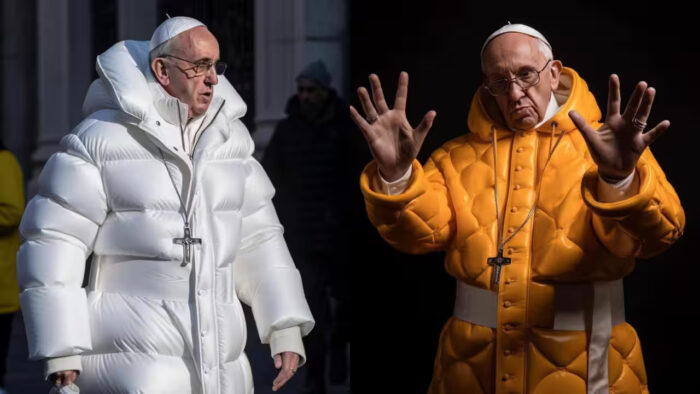
Picture: “Balenciaga Pope” AI image.
Credit: MidJourney/Pablo Xavier