




The study ““Am I a Journalist?” Lifestyle Journalists’ Discursive Construction of Their Profession Inside, Outside, and Alongside the Journalistic Field” by Lydia Cheng and Bunty Avieson from University of Sydney looked at how lifestyle journalists understood and positioned themselves within the journalistic profession.
Lifestyle journalism has been thought as a “lesser” form of journalism, because it is not civilly oriented nor does it serve in the role of watchdog in a democratic society. However, some, such as Deuze and Witschge (2018) have called for extension of the understanding of journalism beyond political journalism.
In this study, the authors contribute to the discourse on lifestyle journalism by looking at how 31 Singaporean lifestyle journalists construct their professional identity by interviewing them. The interviews were semi-structured and in-depth. The author also notes that rather than serving as a watchdog, the Singaporean press operates under governmental control.
The responses were categorized as being part of in-group and out-group discourses, and also noted the emerging “standalone group” discourse, where the interviewees viewed themselves as a separate profession from traditional journalism.
Typically, according to Deuze (2005), journalists use five discursively constructed values to define their professional identity, namely: public service, objectivity, autonomy, immediacy, and ethics. The lifestyle journalists in this study did not conform to any of these values, and thus can be considered an outgroup.
According to one interviewee, whereas political journalists provide a public service, she provides public entertainment. This perception was especially exacerbated by the COVID-19 pandemic and the Ukraine war: many interviewees questioned the importance of their work. Typical was also the “need” vs. “want” discourse: the lifestyle journalists report on things that are not needed to know but that people want to know.
Objectivity was also related to seriousness by many interviewees, who did not consider their work to be serious enough to be considered journalism. This is related to the view of the public sphere as a “masculine” space of rational debate, whereas the domestic sphere is seen as “feminine”, emotional and involved.
Autonomy and ethics was also an area where the lifestyle journalists felt conflict: the need to be commercially independent was not seen to be fulfilled in lifestyle journalism, where the practitioners were indeed trying to sell something.
Immediacy was also not as much of a concern in lifestyle journalism, where an interviewee emphasized that they can take their time to write a story. One interviewee referred to the pace as “very relaxed, very chill”.
The outgroup identity was further amplified by external sources: the organisational environment, the lack of professional validation such as Pulitzer Prices, and by the relative lack of peer recognition.
However, there were also factors that supported in-group identification. The interviewees emphasized that they needed the same skills and followed the same norms as did political journalists, and even further claimed that lifestyle journalism needed more creative writing skills than factual, reporting journalism.
Also, lifestyle journalism sometimes gathers more clicks than political journalism and thus, when part of the same organisation, helps to ensure the economic survival of both. The lifestyle journalists also performed pr for the firms and were expected to look more presentable than the “political news guys”, which the authors likened to “invisible woman’s work”.
In the context of Singapore’s strict governmental controls on political journalism, lifestyle journalism sometimes serves in the role of an alternative political space: the lifestyle journalists can include controversial topics within their stories in a subtle way. While some emphasized that it is not really their responsibility to do so, this further helped lifestyle journalists to feel as an in-group vis a vis journalism.
The interviewees also identified themselves as a distinct group divorced from journalism’s boundaries. The interviewees were non-committal and questioning when asked about whether they were a journalist or not. They might identify as “lifestyle”, “food”, “fashion” journalists, but not simply a journalist – believing that this should be reserved to hard news.
Some even preferred to call themselves something other than a journalist: referring to themselves as writers, for example. This standalone identity was further strengthened by the fact that they saw themselves as being judged by different metrics than (political) journalism.
The authors posit that the fact that lifestyle journalists are seeking to create a standalone identity means that they are currently embroiled in a process to create a discursive process of trying to construct a distinct and separate professional identity complementary to political journalism.
In conclusion, the emerging standalone identity shows that journalism’s boundaries are not necessarily binary – just in-group and outgroup. The heightened political role by Singaporean lifestyle journalists was also of interest in the study.
The article ““Am I a Journalist?” Lifestyle Journalists’ Discursive Construction of Their Profession Inside, Outside, and Alongside the Journalistic Field” by Lydia Cheng and Bunty Avieson is in Journalism Studies. (open access).
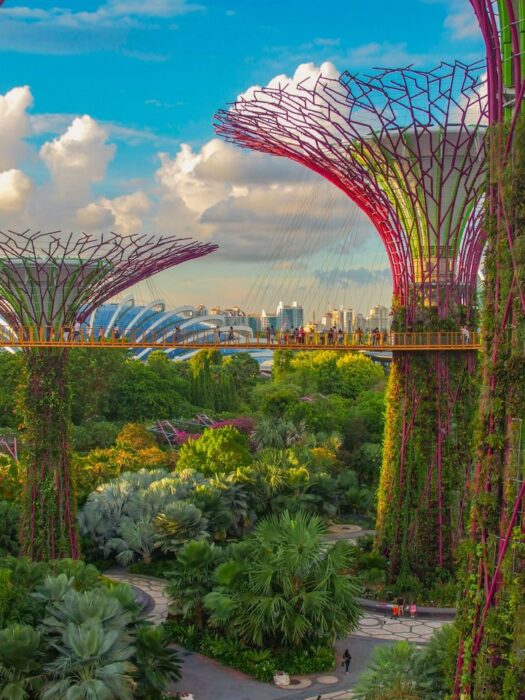
Picture: Singapore gardens by Coleen Rivas
License Unsplash