




This article by Elise Daniaud-Oudeh from University LUISS Guido Carli analyzed the role of visuals dedicated to heritage and culture in social media by Russian war reporters covering military operations in Syria from October 2015 to March 2020.
War correspondents participate in ideological framing and propaganda in conflicts. Teaiwa (1999) has coined the term “militourism” to explore wartime service that contained touristic elements.
However, Russian journalists, according to the author, do not clearly separate their journalistic and private touristic practices. This manifested in social media activities where professional reporting was mixed with “simple citizen” testimonies. Unlike in past times, journalists in the 21st century do not just publish for press outlets, but also on social media.
Russia intervened in the Syrian conflict due to Putin’s decision to support his ally Bashar al-Asad, and as a result, Russian journalists were granted full access to travel the country. At the same time, the Syrian Government suppressed other local and foreign voices, which sought to offer a different perspective.
The sources of the analysis were 5448 public posts by nine war reporters on their professional accounts between October 2015 and January 2020. This corresponded with the most intensive phase. The pictures were thoroughly analyzed with the help of computer-assisted data analysis and topic-coding software MAXQDA.
According to the findings, the most frequent topic in the visual corpus was “human representation” at 43%, out of which 44% also included the journalists. In these, 62% were with journalists wearing press jackets or military clothing, while the rest 38% were in civilian clothing.
Culture and heritage accounted for 27% of the photos, and included landscape pictures and pictures of seaside and resorts and such. 20% were about military operations, and 10% were titled to be about “war devastation”. These categories created a striking contrast between beauty and devastation.
As individuals, the Russian reporters showcased themselves as war reporters with pictures and visuals where they were posing with fighters and such or by taking selfies when they were testing military weapons or running with troops, or acting as one of the militias. It seemed that they took into account the fact that in social media, audiences are more likely to engage with pictures with faces, thus the pictures had faces.
Pictures of otherness and orientalist practices were also observed. Here, the reporters posed in cultural sites or experimented with the local cuisine or did cultural practices such as smoking nargileg, visiting the hammam, or wearing the keffiyeh.
The pictures also reinforced a sectarian analysis of the conflict and reinforced their own cultural biases. In depicting religious sites, the reporters showed Syria as an original Christian land, reinforcing Russian religious messianism and pan-Orthodoxy. Islam was viewed with caution and as more distant, despite the 15 million or so Russian muslims.
In conclusion, the relations of the reporters with the local Syrians reflect a “touristic gaze” that led to a certain reading of the conflict. Their strategy appears to be not presenting the opposition and hostile populations, but to juxtapose images of beauty with images of devastation. The author sees the research as offering paths for further research: they might better help us understand how Russia frames its wars.
The article “Tourists at war: The visual representations of Syrian cultural and heritage sites as instrumentalized by Russian war reporters on social media, 2015–2020” by Elise Daniaud-Oudeh is in Media, War & Conflict. (Free abstract).
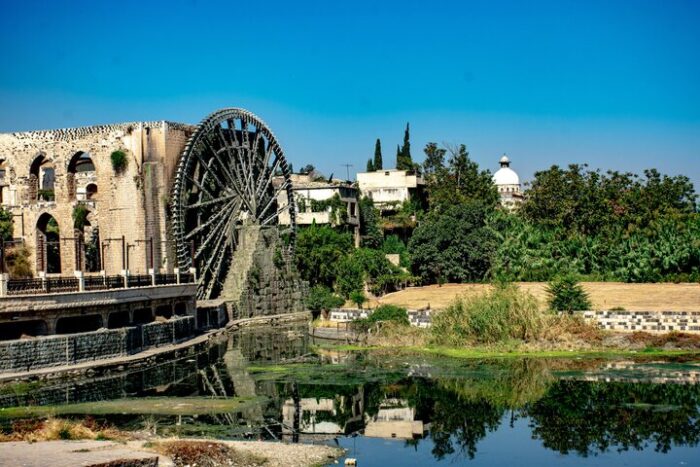
Picture: brown and gray concrete building near body of water during daytime by hosein charbaghi