


The study “Conspiracy Theorists as Alternative Journalists” by Juliette De Mayer from Université de Montréal and Florence Le Cam from Université libre de Bruxelles looked at how conspiracy theorists have sought to seize professional attributes of journalism.
The article deals with two people, who are viewed as conspiracy theorists: Dominique and Camille. The former has a degree in journalism and has worked in mainstream journalism, but is nowadays greeted with suspicion when announcing an intention to attend a professional convention of journalists.
The latter has two Master’s degrees in social sciences, and has some experience as a school teacher, and created an “anti-productivist” magazine in the early 2010s, which has an online and print version. Camille is extremely critical of journalists, making the commitment to journalism paradoxical.
A qualitative, inductive analysis of two critical incidents was conducted. The first involves Camille, who was asked to be part of the group of journalists attending government press conferences, but later lost access due to being deemed “political” and biased. Eventually Camille appealed and was granted access.
The second involves Dominique, who appealed to readers to launch complaints to the local Press Council about opinion pieces in the mainstream media, which Dominique claimed were not complying with journalistic ethics.
A variety of textual and multimedia sources were collected about the incidents. Each document was subjected to close reading and broken into smaller fragments. In them, Dominique and Camille positioned themselves “as the defenders of journalism, as the only ones to practise it properly”.
They sought to position themselves as heroes and victims of censorship. Their followers allege a conspiracy by the authorities in censoring them. Comparisons to George Orwell’s 1984 were made, and Dominique was deemed to be a ‘real journalist’.
In their criticisms of mainstream media, the two ‘conspiracy theorists’ were in line with traditional media criticism, and made similar allegations, such as that mainstream media is too close to those in power. It was also in line with some journalistic values, such as the role of watchdog.
What makes these two stand apart is their commitment to beating journalism at its own game, rising above the limits of traditional journalism. Hence, they end up rejecting the core ideas of traditional, mainstream journalism – but for all their virulent criticism, they do not propose different set of rules, instead seeking to do “journalism better”.
The two also show attributes of traditional journalists: such as press card, participation in meetings of the professional journalists’ association, a university education in journalism, and the title of “independent journalist.”
Nevertheless, despite denying the title, it is clear that the two are conspiracy theorists, with their discourse containing leaps of logic typical of the conspiratorial genre. Obviously, the authors acknowledge that the materials are limited and future research could look at other conspiracy theorists / alternative journalists.
The article: “Conspiracy Theorists as Alternative Journalists” by Juliette De Mayer and Florence Le Cam is in Journalism Studies. (Free abstract).
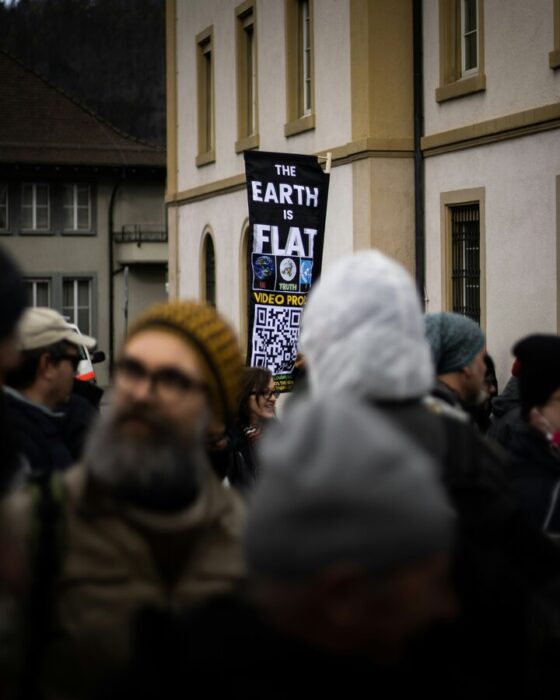
Picture: a big protest in liestal against the corona pandemic mesurments (sic)
By Kajetan Sumila.
License Unsplash.