





The study “The news values of fake news” by Bashayer Baissa from University of Birmingham and Taif University, and Matteo Fuoli, and Jack Grieve from University of Birmingham analyzed fake news discourse through the lens of news values.
Fake news is not a new phenomenon, but has recently garnered attention due to it leading to negative outcomes for example with misinformation about the Covid vaccines or contributing to Brexit with misleading claims about immigration. Past but quite recent research has focused on the linguistic characteristics of fake news. Even more recent and new is focus on stylistic characteristics in fake news discourse.
This study contributed to the research on fake news by studying them through the lens of news values, which itself is a well researched topic in journalism research. News values are defined (Harcup and O’Neill 2001) as “a set of criteria that journalists and editors draw on to decide if an event is worth covering”.
Bednarek and Caple (2017) define the following as news values in Discursive News Values Analysis (DNVA): Aesthetic appeal, Consonance, Eliteness, Impact, Negativity, Personalization, Positivity, Proximity, Superlativeness, Timeliness, and Unexpectedness.
The authors of this study compiled a corpus of fake and real news articles focusing on three topics: climate change, vaccinations, and COVID-19. They found fake news by using reputable fact-checking websites (Snopes, PolitiFact, FactCheck.org, AFP Fact Check, and Reuters). They had to be rated “pants on fire”, false, or mostly false.
The first finding was that fake news used a lot of connecting ideas by building up cause and effect relationships that applied to the audience’s sense of logic. Evidentiality was present in how evidence was presented, for example in climate change it was claimed that incongruent data was kept quiet.
Fake news also frequently employed evaluative language. Here, established theories were evaluated as false while new conspiracy theories were evaluated as credible or proved, for example the existence of the so-called “Saint Corona” patron saint against epidemics. They also attacked the rationality of mainstream media and its believers.
Science was employed too, in using scientific terms to appear more authoritative – deploying scientific discourse strategically. Time was also visited often to revisit past events and challenge established narratives.
Corpus-specific terminology was also present, for example here in referring to China’s biological warfare plans to bolster the claim that Covid-19 was a government creation that leaked from a lab.
In DNVA terms, the values fake news incorporated were negativity, unexpectedness, and consonance. Negativity is in line with previous research on fake news. It has been found out that people are more likely to believe spurious claims if they are in a negative emotional state thus the fake news seeked to further that.
Consonance, on the other hand, taps into the readers’ confirmation bias, which has been found out to be the strongest in emotionally charged subjects, which many of the topics covered by fake news indeed were.
In conclusion, the study shed light on the rhetorical aspects of fake news discourse and also offered insights into the ideological underpinning of this type of discourse. Fake news writers placed a great emphasis on the value of evidence, questioning received wisdom, and approaching topics analytically and seemingly scientifically.
Thus, the authors suggest that, as per Foucault, the fake news draws on the discursive order of science and appears scientifically sound. The insights are also crucial in providing effective countermeasures.
The article “The news values of fake news” by Bashayer Baissa, Matteo Fuoli, and Jack Grieve is in Discourse & Communication. (open access).
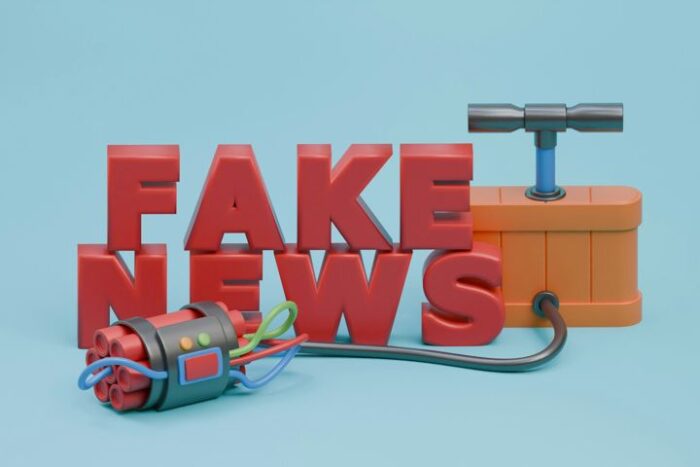
Picture: Fake News Explosion. 3D Render.
License Unsplash.