




The study ““No longer the haven of tolerance”? The press and discursive shifts on immigration in Sweden 2010–2022” by Michał Krzyżanowski from Uppsala University and Hugo Ekström from University of Gothenburg analyzed, with critical discourse analysis, the shifts in Swedish political discourse about immigration: the apparent negativisation over time in the period of 2010-2022.
The time period saw the marketisation of the Swedish welfare state, and the dismantling of the “exceptionalized” Swedish welfare state and perhaps even an end to the Swedish humanitarian “politics of solidarity”. The time period also saw the rise of “Swedish Democrats” (Sverigedemokraterna, or SD) party in parliamentary elections, their message further amplified by the Refugee Crisis of 2015-2016.
Before the crisis, the Swedish political discourse was characterized by a conspicuous lack of anti-immigration attitudes and the failure of the far-right to capitalize on immigration scares, despite there having been an initial scare in the 1980s. This all changed with the Refugee Crisis in 2015 where ever-more negative attitudes were brought to political discourse and the wider public imagination.
The changes in public discourse did not only come from SD, but from several mainstream political parties, leading into negative politicization of the issue. This process portrays multiculturalism and immigration as challenges or threats, this way of thinking gradually becoming the new normal. Existing studies also confirm this normalization.
The empirical data comes from articles published in national, Swedish liberal and conservative broadsheets (Dagens Nyheter, DN, and Svenska Dagbladet, SvD), and in tabloids (Aftonbladet, AB, and Expressen, Ex), in addition to widely-read regional newspapers (Göteborgs-Posten, GP – published in West-Swedish Gothenburg, and Sydsvenskan, Syd – published in South-Swedish Malmö). The articles were collected with Mediearkivet (Retriever Research) database.
The corpus of articles was narrowed down to 952 articles in total after focusing on 14 day period between and after election. Then even that was reduced to 290 articles after focusing on immigration-themed articles and these were put under close critical discourse analysis.
The preliminary analysis revealed some key periods: in 2010 and 2014 SD focused on immigrants on the one hand and Muslims/Islam on the other hand and called for stricter immigration policy. The framing on 2014 focused on us/them dynamics about prioritizing welfare for natives and othering the immigrants.
In 2018 and 2022, the topic was more diversified both in topics and in the parties involved in voicing concerns about immigration. The political spectrum arguing for an arguably illiberal position with restrictions. The Refugee Crisis of 2015 emerged as a dividing line between election-centered time periods.
The in-depth analysis revealed an “ever more persistent distancing between “us” and “them,” and to creation of the persistent nativist imaginary that eventually enabled gradual introduction and recontextualisation of frames emphasising the rights of natives over the “non-native them.” The reader was constructed as a native, with an implication that the journalists were writing for us, what the author terms as “phatic communion” based on Malinowski (1920).
A second feature was the construction of the Swedish self-image, particularly from 2015 onwards. Sweden was presented as being a fortress of liberalism and tolerance, and this image was believed to be internationally held. But at the same time, the image was seen as changing particularly with the rise of SD in elections.
One feature that the authors also noticed was that the voters of SD were presented as being non-xenophobic, which contributed to the normalization. The tactic here was seen as “legitimation through path dependency” (as per van Leeuven 2007) – i.e. showing the rise of SD as part of a natural process.
In conclusion, the study confirmed the authors’ hypothesis that anti-immigration stances had become more normalized and negativisation had occurred . It is crucial to note that the process occurred with strategic manufacturing of hybridity and ambiguity and without the press self-positioning explicitly. The impression was given “that while the press in itself remained objective, there was a wider negativisation of social and political views on immigration that was “anyway” already in progress and commonplace”.
It seems that during the time period Swedish political discourse had started to resemble elsewhere in Europe where the presence of far-right is a given and is a source of illiberal, exclusionary imagination.
The article ““No longer the haven of tolerance”? The press and discursive shifts on immigration in Sweden 2010–2022” by Michał Krzyżanowski and Hugo Ekström is in Social Semiotics. (free access).
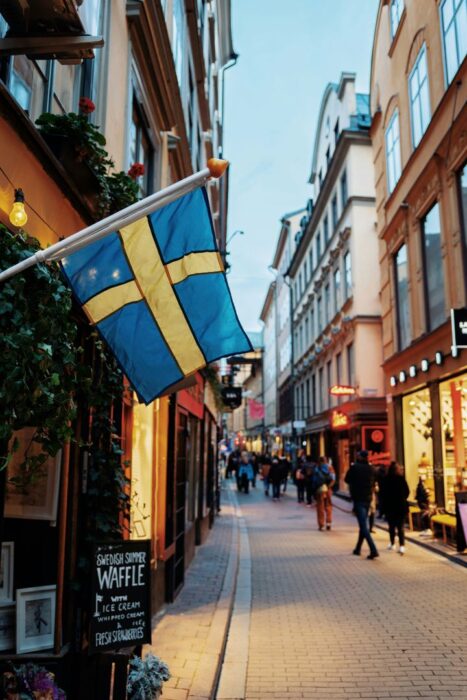
Picture: Gamla Stan in Stockholm, Sweden by Linus Mimietz.
License Unpslash.