





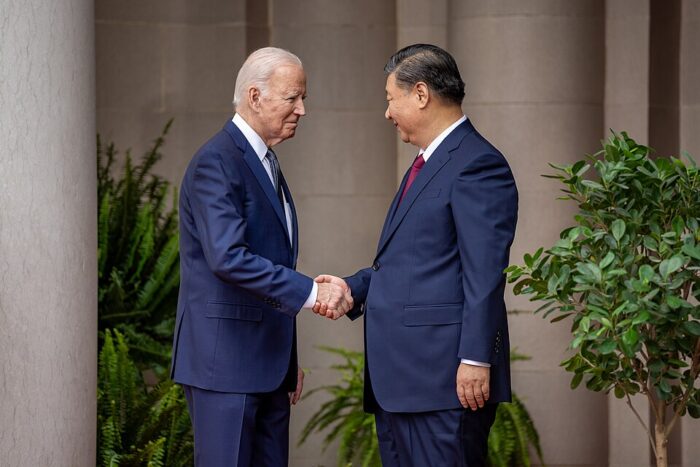
The review article “Handshake or standoff? Global media and the high stakes of Sino–American diplomacy” by Xiaoling Zhang from Xi’an Jiaotong–Liverpool University looked at media portrayals of the summit between Xi and Biden in San Francisco November 2023 through analyzing other research articles. The media portrayal was not investigated just in China and the US, but also in the United Kingdom, Japan, India, and Southeast Asia.
According to the author, the bilateral relationship between China and the United States is the consequential one of the 21st century. This relationship has been fraught with occasional antagonism between the two countries, as well as cooperation. Since the 2020s, the relationship has once again taken a turn for the worse, and according to an earlier study by the author (Zhang 2020), are now in the most serious situation since the formation of the relationship in the 1970s.
Media framing of diplomatic events not only covers the events, but also has a role in the construction of foreign policy narratives. According to Hallin (1986) and Entman (2008), journalism has a critical role in the legitimization of particular interpretations – making the representations of diplomatic summits non-neutral and embedded to national ideologies and historical memories.
In China, according to Zhang and Shaw, both the People’s Daily and China Daily portrayed the summit positively. The difference was that the People’s Daily targeted a more domestic audience and had themes of harmony, stability and China’s global responsibility and thus reinforced internal unity and regime legitimacy. China Daily had a more international audience and acknowledged tensions. The author states that these differentiated frames reflect the dual communication strategies of a centralized media system.
Lewis and Lai looked at how the British media, The Guardian, the BBC, and the Daily Mail interpreted the event. They all, with some differences, expressed concerns on China’s challenge to the U.S. led Western hegemony. The framing was shaped UK’s post-Brexit recalibration and the evolving China policy.
The Japanese media, according to Diao and Yu, reflected the country’s aim of balancing its economic ties with China and the security alliance with the United States. Thus, the media there framed the summit as U.S.-China confrontation. Yomiuri, a conservative outlet, emphasized security concerns and was more skeptical of China, while the liberal Asahi was more diplomatic.
Adhikari looked at the Indian media, and it reflected India’s role as an emerging power, the media, The Hindu and The Times of India, framed the summit as a step toward global stability but remained cautious of China, also reflecting the country’s stance.
Southeast Asian media, according to Ong, revealed, across Singapore, Malaysia, Indonesia, and the Philippines, revealed a focus on national interest and regional stability. The framing reflected ASEAN’s strategic hedging and preference for multipolar world order.
In conclusion, the media responses suggest that the global perceptions remain fragmented when it comes to Sino-U.S. relations. Trade tensions are not merely economic disputes but deeply political confrontations and this is amplified by the global media. The language used in the framing shapes public perceptions, market reactions and policy decisions.
The article “Handshake or standoff? Global media and the high stakes of Sino–American diplomacy” by Xiaoling Zhang is in Global Media and China. (Open access).
Picture: President Biden meeting with President Xi, from Wikipedia.








.jpg)