




The study “Reporting Kalgoorlie and Broken Hill Prostitution 1896–1903” by Belinda Beattie studied two local newspapers in the Australian Federation, in mining towns, in the turning point of the 19th and 20th century, Kalgoorlie Miner from Kalgoorlie in Western Australia and Barrier Miner from Broken Hill in New South Wales. The viewpoint was on how they framed prostitution in order to appear respectable.
Prostitution at the time in Australia were synonymously called ‘Soiled doves’, ‘scarlet,’ ‘unfortunate,’ and ‘fallen women’ and came in two varieties: sole traders of “syndicated” prostitutes in a brothel under a Madame – the latter variety included a large amount women tricked into the trade upon arrival.
These were characterized in the newspapers as White Slave Trade and it was not uncommon for newspapers to frame the issue of prostitution in the sense of victimization of women – but this victim status was surprisingly not often afforded to sex workers.
Some of the previous research on historical Australian prostitution has also focused on Kalgoorlie, but this study adds to that research by focusing on how newspapers have contributed to Othering.
Sociologist J.F. Staszak claims that those who do not reflect community values are subject to othering, defining it as: “a discursive process by which a dominant in-group (‘Us’, the Self) constructs one or many dominated out-groups (‘Them’, Other) by stigmatizing a difference—real or imagined—presented as a negation of identity and thus a motive for potential discrimination’”.
Of the two newspapers analyzed, Kalgoorlie Miner reported on prostitution significantly more. This is not a reflection of less prostitution in Broken Hill: the town had an unusually high proportion of prostitutes among its female prisoners. Instead, it suggests strict editorial gatekeeping and less community demand for stories about prostitution.
Four frames were found amongst the articles from the newspapers: 1) policing and court, 2) moral judgement, 3) creating the desired community, and 4) local council. The first was the by a large margin the most common in Broken Hill (78,3% of articles), and the second most common in Kalgoorlie (31,96% of articles).
Policing and court articles in Kalgoorlie were about the police’s inability to monitor, control and prosecute prostitution with mixed court success. In Broken Hill, it was opposite: the stories were often about the successes of the police against prostitution.
Moral judgement was the second most common in Broken Hill (5,4% of articles) and the least common in Kalgoorlie (9% of articles). In these articles, prostitution was Othered, it was not only a sin but also failed to uphold the values of the community. In Broken Hill, Thomas Wellington applied to Christian morals in his letter to the editor, resonating with the highly Christian (97%) community. In Kalgoorlie, this role was performed by the Women’s Christian Temperance Union.
However, the counterpart of condemnation was redemption for Christians: both newspapers ran stories of women rescued from prostitution or children born of prostitutes. There was also an another layer of othering in the case of prostitutes from foreign heritage, such as from Japan (the Karayaki-san).
Creating the desired community frame was present in 15% in Broken Hill, and 53% of Kalgoorlie – the most common. Please note that this is in the words of the author: 15% is more than 5,4% in the last category which was supposedly the second most common. There may be a correction pending.
In this frame, the stories advanced the importance of creating a family-friendly community: pressure was applied on the city council to either rid or at least the hide the moral evil: the Other. Kalgoorlie was more middle class, while in Broken Hill Unionism and Labourism presided.
Local Council was present in 1,3% of Broken Hill articles and 7% in Kalgoorlie. In Broken Hill, it was about the passing of a council by-law penalizing proprietors of prostitution with fines. Kalgoorlie reported only on one conviction, that of Ellen Webster. Kalgoorlie Miner pressured the local council to take more decisive action against prostitution.
The study adds to the scholarship in Kalgoorlie and also explores a less common palace, Broken Hill. Christianity and White civility were invaluable as community touchstones, and the newspapers rallied the readers against the Other of prostitution. Comparing similar mining communities was a good idea and provided valuable insight about the process of Othering.
The article “Reporting Kalgoorlie and Broken Hill Prostitution 1896–1903” by Belinda Beattie is in Media History. (open access).
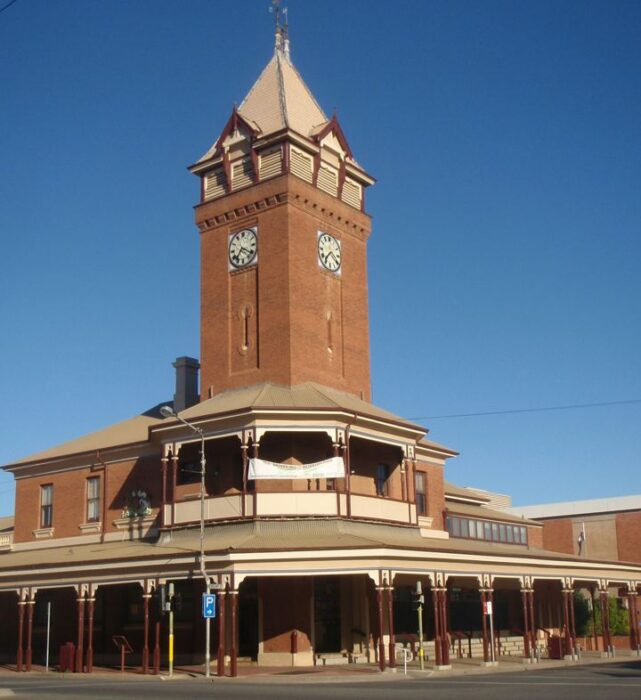
Picture: clock tower in Broken Hill, NSW, Australia by Jen Wood
License Unsplash.