





The first year of the civil war in Sudan started on April 15th in 2023. Oussama Badad and Omar Kouiyache from University of Ottawa studied the framing of the conflict in three pan-Arab media outlets: Al Jazeera Arabic, Al Arabiya, and Sky News Arabia.
Despite the lack of widespread coverage in the Western media – this could even be called neglect – the Sudanese civil war ended up being one of the worst humanitarian catastrophes in the World with over 12 million displaced people and widespread famine.
The conflict between the Sudanese Armed Forces (SAF), led by General Abdel Fattah al-Burhan and the paramilitary Rapid Support Forces (RSF) of General Mohamed Hamdan Dagalo began as a power struggle in Khartoum, but soon spread across the nation.
Pan-Arab media was the one to cover the conflict in detail, and understanding the political economy of it is foundational in understanding the narration. Based on a significant amount of scholarly research on the topic, these outlets do not operate based on a unified “Arab” narrative but have their own framing (Abdullah and Elareshi, 2015; Ajaoud and Elmasry, 2020; Fahmy and Al Emad, 2011).
An example of the differences in framing is that Al Jazeera covered the Israel-Palestine conflict by aligning itself with Qatar’s support of Hamas, while Al Arabiya reflected Saudi Arabia’s hostility towards Hamas.
When it comes to African and Sudanese conflict coverage, the framing was dominated by a simplistic view of the conflict as being primarily ethnic and the political context is seen as more important than the human suffering. The journalists also heavily relied on sources that reinforced the existing frames.
The framing theory of Entman (1993) formed the basis of the theoretical framework and the research questions were (no hypotheses because the state-sponsored design did not point in one predictable direction):
RQ1: How did Al Jazeera Arabic, Al Arabiya, and Sky News Arabia vary in their framing of the Sudan War during its first year of coverage?
RQ2: How did the three outlets vary in their primary and secondary source selection in coverage of the Sudan War?
RQ3: How did tone toward the SAF and the RSF vary across the three outlets?
RQ4: How did the civilian casualty reporting vary across the three outlets?
A comparative content analysis was done to study the three outlets: the three prominent news outlets were chosen to represent the ideological and geographic diversity of Arab media. The chosen outlets are also among the most watched Arab-language news sources in the Arab world.
The sampling frame for the articles was from April 15, 2023 to April 15, 2024 – the full first year of the conflict. There were 761 eligible articles from Al Arabiya, 734 from Al Jazeera Arabic, and 602 from Sky News Arabia. The final sample had 100 from each.
Across the sample, the conflict frame was the most prevalent, followed by human interest, then responsibility, strategic/geopolitical, security, and economic. There were significant outlet-level differences in all six frames. Al Jazeera Arabic applied the conflict frame in every article, while Al Arabiya in 75%, and Sky News Arabia in 59% of the articles. Also Al Jazeera used the responsibility frame the most.
When it comes to the sources, Al Arabiya relied most on the SAF/Sudanese Gov. category (32.0%), with Sky News Arabia at 21,0%, and Al Jazeera at 13,0%. This suggested that the Saudi-backed outlet relied most on official government sources. Sky News Arabia stood out in its wide use of civilian sources (19%). Al Jazeera, on the other hand, used unidentified sources the most (11,0%), and “other” sources (31,0%).
The tone also varied. Al Jazeera Arabic and Al Arabiya were notably more positive towards SAF, while Sky News Arabia was almost uniformly neutral (86,0%), and had a higher amount of negative coverage (16,0%). RSF was treated neutrally or negatively across all outlets. Al Jazeera was the most negative toward it (53,0% negative, 45,0% neutral).
Civilian deaths were reported unevenly, with Al Jazeera using the most numeric estimates (43,0%) compared to Al Arabiya (40%), and 32,0% in Sky News Arabia that also had the highest proportion of articles not mentioning civilian deaths (60,0%).
In conclusion, the study extended the analysis of framing to a conflict where Arab states are implicated, not just observers, and showed how ownership-based alignment operates through de-emphasis (Sky News Arabia) and not just overt advocacy. It also showed that the “other” category can have editorial meaning, not just being a coding gap.
The article “Fractured lenses: A framing analysis of Sudan’s civil war in Pan-Arab media” by Oussama Badad and Omar Kouiyache is in Media, War & Conflict. (Open access).
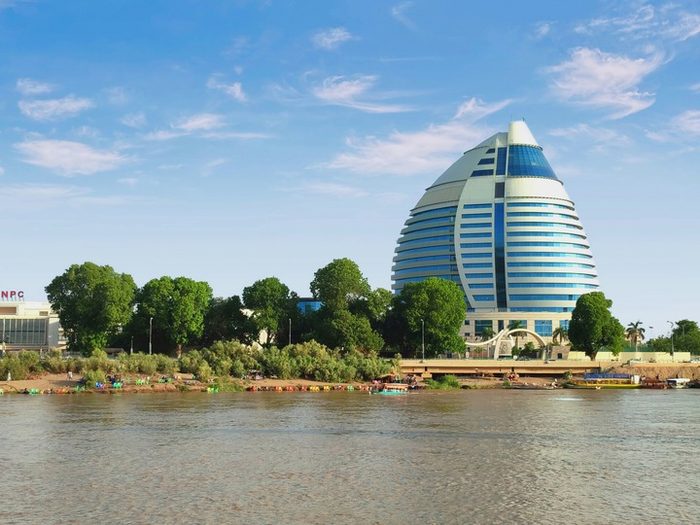
Picture: Nile Street, Khartoum, Sudan.
License Unsplash.