




The article from last month by Kunhao Yang from Shibaura Institute of Technology and Mengyuan Fub from Waseda University deals with Japanese media news narratives about heatwaves, and how these narratives link, or fail to link, extreme heat to climate change.
Heatwaves are defined as sustained periods of abnormally high temperature, and have emerged as the most consequential extreme-weather hazards, according to research. And they have recently grown more extreme and frequent. The news media functions as agenda setters and narrative framers.
This is particularly true in Japan, which has hot-humid summers that intersect with rapid population ageing and dense urbanisation. They have led to heartstroke hospitalizations. The news coverage thus has implications for national risk perception, individual protective behavior, and policy responses. Among related topics, seasonality remains underresearched.
The study utilized a large-set dataset from Yahoo! News Japan, which after some elimination resulted in 5040 heatwave-related articles. The authors assessed the linear association between daily heat-wave-wave news coverage intensity, operationalised as the percentage of heat-wave-related articles published each day and daily temperature. Pearson product-moment correlation coefficients were used, and Granger causality tests were employed later.
A noteworthy pattern was discovered after rigorous analysis: heatwave coverage during hot periods focused more on personal adaptation and meteorological descriptions, coverage during the cooler period emphasized broader social impacts.
The authors note that the Japanese media coverage of heatwaves is not educational in terms of climate change, as the discussion is not extended to climate change discussion during the hot period. This could be due to practical difficulties in news coverage, as the weather forecasters had no time left to mention climate change.
It was also noted that there were audience complaints from both those who care about climate change and denialists, who accused the media of being fraudulent and spreading conspiracy theories. During cool periods, there was not much focus on social problems caused by heat, suggesting that coverage is linked to social agendas following seasonal trends.
All in all, the findings revealed an incongruity between sensory experiences and the explanatory depth. The authors noted a need to connect personal sensations with the connection between heatwaves and climate changes. They made three suggestions: 1) embedding climate trend attributions during peak heat; 2) leveraging vernacular cues to signal the disruption to the familial calendar; 3) pair advice with cause by coupling protective guidelines, especially for vulnerable groups, combined with explanations of the cause of the heat.
The article “Heat in Real Time, Climate in Retrospect: Mapping Seasonal Gap in Japanese Heatwave Journalism” by Kunhao Yang and Mengyuan Fub is in Journalism Studies. (Open access).
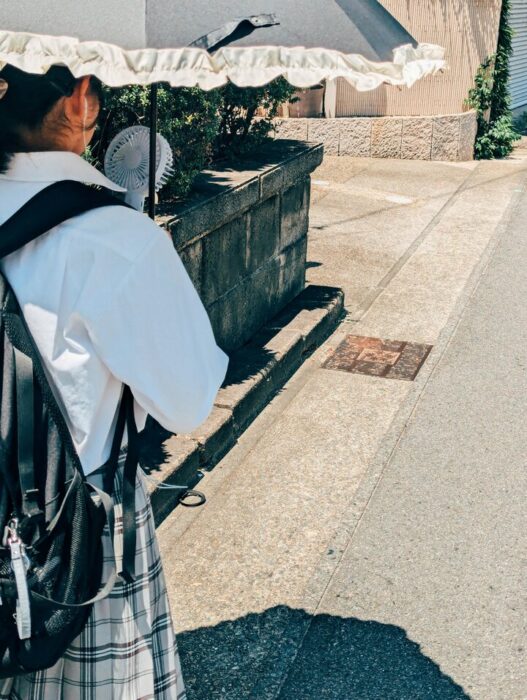
Picture: From Uji, Kyoto, Japan by note thanun.
License Unsplash.