




A quite recent article on news framing in Egyptian hyperlocal journalism by Hossam Elhamy and Azmat Rasul from Zayed University investigated the the interaction between power, news practices, and editorial adaptation strategies in a fragile media environment.
Egyptian journalism started during the invasion of French troops in 1798-1801, as following the departure of the French, Muhammad Ali started a massive modernization project and established the Bulaq Press, a publishing house. The first local newspapers started appearing later, first privately owned, then from 1952 on government publications.
Also since 1952, the media system has been subordinated to the political regime. It has since been marked by a balance between state control and content diversity until 2011. After the Arab Spring, digital media has been a vessel of sociopolitical change, and there was a period of openness.
The authors tackle the underresearched Egyptian context and propose two research questions:
RQ 1: What are the main news themes, news frames, framing orientations, and framing techniques employed by Egyptian hyperlocal journalism when covering local community news?
RQ 2: To what extent do elite-driven advocacy frames displace or coexist with local community-driven frames within the Egyptian hyperlocal journalism landscape?
A quantitative content analysis was utilized here utilizing inductive and deductive approaches. The sample consisted of six hyperlocal Egyptian newspapers for a total of 770 local news items.
There were 30 frequently used news frames to represent local elites such as governmental elites and local community issues. Positive frames dominated, 61,5% of the frames had a positive orientation towards the local elite – meaning that the city government was represented more than resident voices, similarly to Mesmer, Frazier, and Burgess’ (2022) findings. Top-ranking themes and frames were also linked to criminal reporting, like with D’heer and Paulussen (2013).
The hyperlocal journalism used strategies to appear professional and community-oriented while still adhering to what is termed a “loyalist press model”. The authors note that the sociopolitical environment and the challenges surrounding hyperlocal journalism influence the news framing strategies employed.
Also, the fact that only four of the websites remain active after the analysis, with one moving to social media and one ceasing operations highlights the vulnerability of these outlets, supporting the central argument that hyperlocal journalism struggles to survive.
In conclusion, the study recommends prioritizing professionalism for hyperlocal journalism – necessitating an economic business model that allows self-sufficiency and independence. Future research could explore factors influencing hyperlocal news framing, compare them with audiences’, and compare different countries.
The article “Framing as a Survival Strategy in Fragile Media Contexts: News Framing in Egyptian Hyperlocal Journalism” by Hossam Elhamy and Azmat Rasul is in Journalism Practice. (Free abstract).
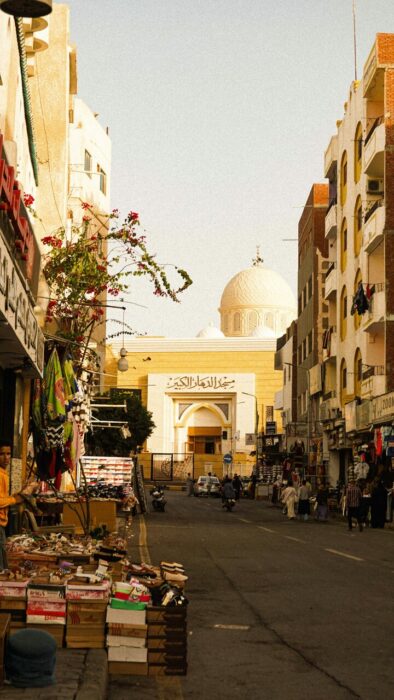
Picture: Hurghada, Egypt by Anja Lee Ming Becker.
License Unsplash.