




The study “‘NO PLANS OR THOUGHTS’ Deliberating Wartime Censorship in Cold War Denmark” by Iben Bjørnsson examined the case of Danish preparedness planning during the Cold War and its effects on facilitating a shift in the Scandinavian media system.
The issue of press freedom during times of war remains contested, despite the importance of press freedom as a fundamental principle in most Western societies. Previous wars involving Western belligerents have seen a variety of solutions striking a balance between freedom and wartime considerations: from more or less voluntary agreements during the First and Second World War to almost total freedom during the Vietnam war, to nearly total censorship during the Falklands war, to the embedding of media with troops during the Western coalition’s Afghanistan and Iraq operations.
Therefore, the study asks how Danish authorities imagined the role of the media in the case of a possible war between the West and the Soviet Union and its satellites (or a smaller war occurring in the same context between the opposing sides in the Cold War). The author further argues that the answer developed and shifted with a general shift in the Nordic media system.
As materials for the analysis, the author examined documents from the relevant authorities in the Danish National Archives, which has made most materials available for researchers. However, the Danish Emergency Management Agency (DEMA) increased restrictions on the materials in 2022 and seemed to re-classify some materials.
According to the analysis supplemented by previous research, the preparedness efforts sought to create an “imaginary future war” to gather support for national security strategies and a desired social order. The concept of Total War, in the Nordic context Total Defense, which was loosely defined, but sought to encompass military, police, civil defence and civil preparedness planning.
When it comes to press, the Danish press during the Second World War was characterized by a high degree of corporatist cooperation and appeals to press responsibility. During the first decade of the Cold War, the press was guided by 1951 Defence Law, which gave the Minister of Defence broad powers over telecommunication and the press.
In 1955, due to the increasing nuclearization, NATO started urging its member states to prepare civil society for total war, leading to the founding of the Danish Governmental Committee for Civil Preparedness in 1956 in Denmark. Under it, there was a Subcommittee on Press Preparedness (SCPP), consisting of government officials and press representatives.
When deliberating censorship, SPCC considered “actual” censorship to be practically impossible but also democratically problematic and counterproductive.However, the government and a military representative were clear that should amicable relations fail, the government should possess forcible means to ensure favorable coverage. This created tension between the voluntary participation and whether it truly was such.
All in all, the arrangement resembled those of Sweden and Norway during wartime, and can be categorized as democratic corporatist media system involving close cooperation between media and state.
Instead of censorship, the SPCC issued guidelines for wartime publishing. The guidelines were flexible and it was clear that if the war was successful, they could be less draconian and more restrictive if things got worse – again reflecting the total defense ideal.
SPCC was later replaced by a Permanent Committee for Press Preparedness (PCPP), which was more focused on practical planning and execution. Also, the Defense Law of 1960 only covered post, telegram and telephone – leaving the press out. However, an agreement on how the press should function in a crisis was not reached.
A new era started in 1974, when Civil Emergency Planning, and the PCPP with it, was moved from the Ministry of the Interior to the Civil Defence Directorate Erik Schultz as a chairman. During his time, the media system decidedly moved more towards the liberal (individualist) model – with some old guard SPCC demurring that the young generation had less understanding of war and preparedness – as wartime press was no longer bound by a deal.
In 1980, Schultz commented that it is no longer possible to control the press with a “moral code”. Of course, media was still bound by Danish law. Media also acknowledged that while a cooperative press was desirable during wartime, planning for such was out of the bounds during peacetime. Thus, the ideal of socially responsible press still existed, but it was more of a hope than something concrete.
In conclusion, the corporatist press reigned from 1950s to 1970s, but it then started to break up and shift towards a more liberal model, along with the war planning for censorship and press control becoming more liberal and less centrally planned. However, the tension still remained and remains.
The article “‘NO PLANS OR THOUGHTS’ Deliberating Wartime Censorship in Cold War Denmark” by Iben Bjørnsson is in Media History. (Free abstract).
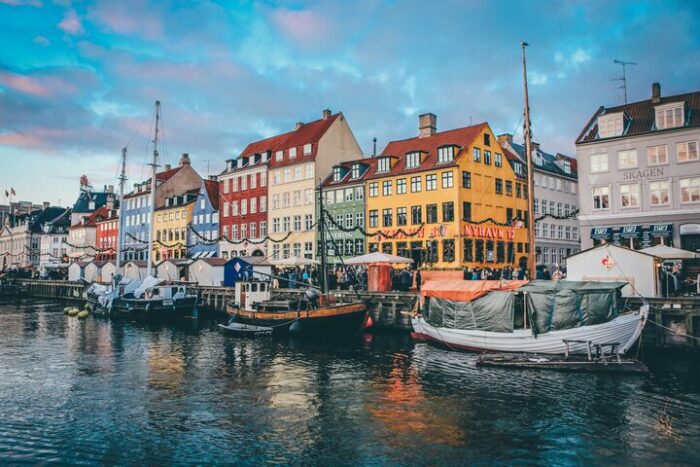
Picture: Nyhavn 17 by Nick Karvounis.
License Unsplash.