




The historical article by Alberto Pena-Rodríguez from University of Vigo covered the diplomatic and propaganda strategies of the Portuguese government related to the non-intervention in the Spanish Civil War, and this in the Portuguese press. This was done qualitatively by analyzing original documentary sources.
After the military coup of 1926, the Portuguese dictatorship by António de Oliveira Salazar developed a campaign in Europe to support General Franco – this was done for the fundamental purpose of survival of his own regime.
Conversely, the Spanish republican system inspired Portuguese republicanism, which also explains why Salazar wanted Spain to be in the orbit of authoritarian countries – there was also the fact than many Portuguese, both Republican and Catholic, were aware of the despotic features of the First Republic, such as religious persecution in some Republican cities. This fear of anticlericalism and the ‘Spanish red peril’ was used by Salazar as an emotional lever.
The documentation analyzed for this consisted of documentation from the Oliveira Salazar Archive and the Portuguese Ministry of Foreign Affairs, and a selection of representative articles from the Diário da Manhã, as well as the Diário de Notícias, O Século, A Voz and the Diário de Lisboa.
Portugal’s support for Franco mainly consisted of maintaining a policy of non-intervention for other countries: denouncing support for the Madrid Republican government – although at the same, there was arms trafficking between Portugal and the Spanish rebel side. This trafficking was denounced by the USSR and newspapers such as the News Chronicle, the Times, or Le Soir.
The Portuguese newspapers supported Salazar’s policy and accused, for example, France of militarily helping the Republican side in the war, claiming that such actions were ‘idiocies’ and that the major French newspapers supported the Portuguese policy.
Portugal also held back from joining the international committee until September 29, 1936, but finally joined after intense pressure from the French and English governments. This coincided with the Soviet pro-Republican offensive in the supranational body, where the Soviet diplomat made Portugal the scapegoat instead of a direct confrontation with Germany and Italy, who also supported the Francoist rebels.
This conflict was turned by the Salazarist press into a matter that affected the sovereignty and survival of Portugal as an imperial power, and used this argument to categorically refuse Russian ships patrolling its waters. However, it was becoming increasingly difficult to win support for the rebel side in England, and subsequently Portugal had to accept the control of its borders.
Nevertheless, the diplomatic and propaganda success of the Portuguese Ministry of Foreign Affairs personally directed by Salazat was naturally widely praised by the Salazarist food – A Voz concluded that Estado Novo’s massive propaganda was necessary to persuade the world about the Portuguese vision of the war in Spain.
In conclusion, the Salazarist coordinated with the Francoist authorities fought against the measures the London committee tried to implement during the Spanish Civil War. Thus, the role of the Portuguese dictatorship was to provide an excellent platform for Franco to promote its image and the political model of ‘New Spain’ in the European scene.
The article “Diplomacy, Press and Propaganda – Portugal, the London Committee and the Spanish Civil War” by Alberto Pena-Rodríguez is in Media History (Free abstract).
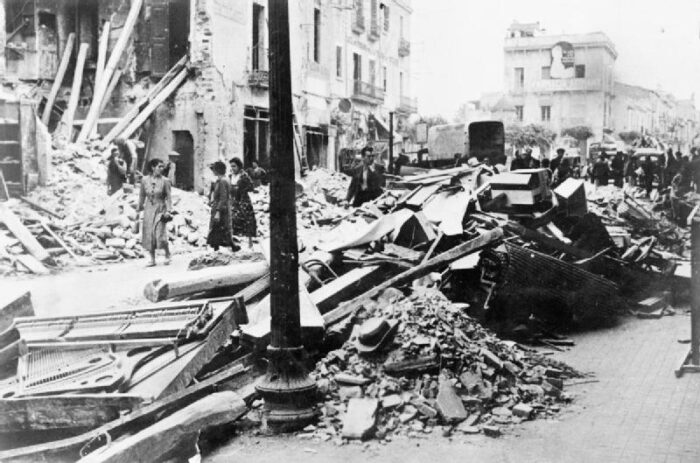
Picture: The destruction wrought on Granollers after a raid
Photograph by Bates Winifred – This photograph HU 33129 comes from the collections of the Imperial War Museums (collection no. 7705-17 )
From Wikipedia, Public Domain