




The study ““Comforting the Afflicted”: How a Small Number of Journalists Fought for Japanese Americans During the Internment” by Reed Smith from Georgia Southern University looked at those few American reporters during the Second World War who sought to end the internment of Japanese Americans and secure their civil rights.
The suspicions towards Japanese Americans began shortly after the Pearl Harbor attack, when the United Press correspondent Wallace Carroll “confirmed” the sabotage rumors that circulated after the attack – namely that Japanese Americans had “infiltrated” Hawaiian public agencies, and that the Japanese pilots supposedly had class rings of Honolulu high schools and Oregon State University on them.
This story was only the first of many, in which the press where the threat of Japanese Americans was played up, particularly about the ones living in the West Coast states. Initially, some West Coast journalists cautioned the readers against thinking that Japanese Americans supported Japan, but soon, by January 1942 they started arguing that Japanese Americans were a threat to national security and called for their removal.
All the suspicions from the press, the population, and the military eventually led president Franklin Delano Roosevelt into issuing Executive Order 9066 on February 19, 1942. This order authorized the removal of “all persons deemed a threat to national security” from the West Coast to relocation centers inland – displacing 125000 people, mainly Japanese Americans by the US Army. Only a few came to their defense, and Japanese Americans’ reputations, livelihoods and lives were ruined.
Nevertheless, the small number of journalists who did champion the civil rights of the Japanese Americans have largely been ignored in the research. These journalists fulfilled not just their journalistic responsibility but also a moral one. This showed that journalism can, at times, influence the nation’s mind towards positive moral results. At times the press also squanders their rights granted by the First Amendment. Both tendencies were evident during the WW2 internments.
Of the writers who supported the internment there were prominent ones like Westbrook Pegler, who wrote things such as ““should be under guard to the last man and woman, and to hell with habeas corpus” and called for punitive killings of them: “executing a hundred detained Japanese for every American killed in the war.”. Even the posthumously highly respected Walter Lippman argued that the reason Japanese Americans were dangerous was because they had refrained from espionage “[o]nly because they had been busy quietly organizing.”
There had been well-integrated Japanese Americans who had launched Japanese or English-language newspapers catering to the Japanese American population. One of such was James Sakamoto’s Japanese American Courier who argued that any consideration the Japanese Americans owed to Japan was nullified by the attack. He also challenged the relocation, but urged peaceful, loyal compliance.
Sakamoto’s attitude was typical of Japanese Americans, but at least two white Washington state journalists disputed it. Walter and Mildred Woodward were outspoken anti-exclusion journalists on the Coast, denouncing the “blind, wild, hysterical” hatred of persons with Japanese ancestry, and apologized to the Japanese Americans. This resulted in several readers canceling subscriptions and angry letters.
Eleanor Roosevelt, the First Lady, also publicly disagreed with her husband’s executive order, but did not actively campaign to overturn it – instead opting to make things better for the people affected by the policy. She also toured the camps, and contested the claims in editorials around the nation that claimed the camp guards “pampered and coddled” the internees.
The author challenges Cheryl Greenberg’s notion that the minority organizations representing Jews and Blacks “did not prove compelling enough to any civil rights agencies to condemn the evacuation order.”. Instead, while Black newspapers may not have commented extensively on the issue, those that did, condemned it and claimed kinship with the struggles of Japanese Americans.
W.E.B. DuBois, writing for The Crisis, suggested that the internment was racially motivated: “Color seems to be the only reason why thousands of American citizens of Japanese ancestry are in concentration camps. Anyway, there are no Italian American or German American citizens in such camps.” Others also saw parallels with the plight of Blacks and Japanese Americans.
When Dillon Myer was appointed the Department of Agriculture’s director of the War Relocation Authority (WRA), the federal agency in charge of internment in 1942, he tried to make the internees’ lives more humane and gradually released many internees to jobs or college enrollment. While many journalists were critical of this, he was also supported by a handful of nationally visible journalists.
For example, one vocal opponent of internment was the radio journalists, called the Dean of Radio Commentators, Hans Kaltenborn. The son of German immigrants, his background and international reporting led to empathy for immigrants. He contrasted the treatment of Hawaiian Japanese Americans – where there were no camps despite the population being one third ethnic Japanese – and there had been no problems, to the mainland: “Why in the world did we have to create one here?”
Kaltenborn also called the internment camps “concentration camps” that were unworthy of the US. He also highlighted the irony that many Japanese Americans were fighting for the US in Europe while their relatives were behind barbed wires in the US.
Of the newspapers of note, The New York Times did not champion the Japanese Americans’ cause, but the Washington Post was the principal ally of Myer and the Japanese Americans. Seldon Menefee there sought to convince the readers that Japanese Americans should be freed, and Alan Barth also wrote editorials opposing internment.
The number of editorials calling for the end of internment grew in number beginning in the summer of 1944, possibly following the example of Menefee and Barth or simply due to changes in the public opinion.
In conclusion, the threat of Imperial Japan brought out the best and the worst in American journalism. Notwithstanding the rumors and the racial hate, the West Coast threat from Japan was to a degree real – but in none of the incidents there, were Japanese Americans implicated, and historians nowadays largely condemn the internment.
The incident during WW2 show that many journalists failed to employ the Society of Professional Journalists Code of Ethics to address the internment and did not seek truth and report it or minimize harm – allowing prejudice to influence their stories, apart from the few, as seen above.
The article ““Comforting the Afflicted”: How a Small Number of Journalists Fought for Japanese Americans During the Internment” by Reed Smith is in American Journalism. (free abstract).
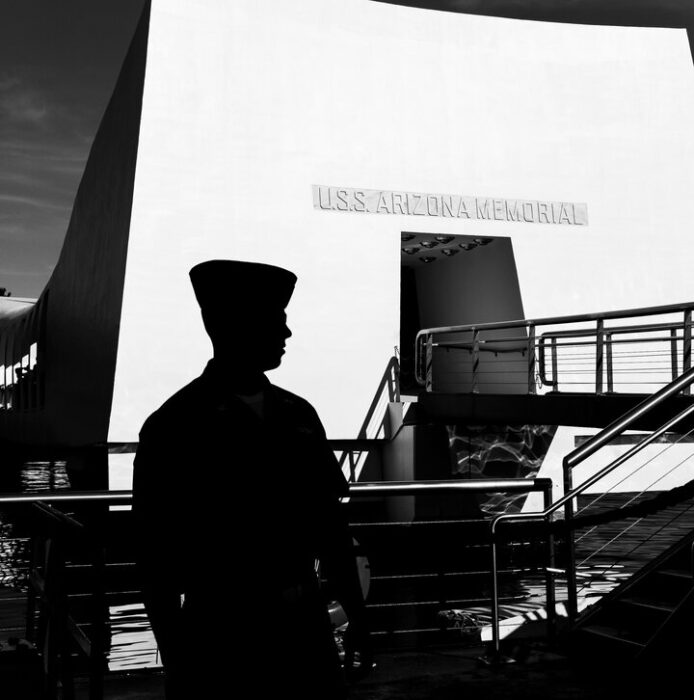
Picture: Pearl Harbor, Honolulu by Ryan Parker.
License Unsplash.