





The American Civil War was a period of upheaval and laid the groundwork for modern U.S. governmental policy – and it is a period that has been equally intensely studied and debated. The period also happened during the decline of the Romanticist movement. Miles Randall and Hanisha Besant from Regent University explored the war’s effects on American journalism in this article.
Censorship campaigns are not unheard of during wars in, also in journalism, such as the famous “loose lips sink ships” during the second World War, as was the conflict between media and the war goals during the Vietnam War. But the earlier Civil War and media have not been studied so much and are not known so widely.
Some scholarship on Civil War censorship does exist, but this study attempts to approach the topic from a unique viewpoint: viewing the relationship between the government and media, from both firsthand and historical accounts from the viewpoint of the Romanticism movement, and its ideals of freedom of speech and independence.
In the nineteenth century, journalists in the U.S. saw themselves as torch-bearers of the noble ideals of the Revolution (against British rule) – linking journalism to the very success of the Revolution and its ideals. Romanticism, an originally European movement, flourished on American soil, bolstered by the likes of Henry David Thoreau, Walt Whitman, and Ralph Waldo Emerson.
However, many journalists during the era were influenced by Emerson’s American Scholar (1837) – a call for Americans to discard the “obsolete European mindset” and embrace the self and to question established norms. Nevertheless, by 1861 Romanticism had fallen out of favor in Europe and was in decline in the U.S.
On the Union side, the war quickly became the most significant topic. However, the excessive detail on describing the Union’s military strength sometimes unwittingly exposed the nation’s weaknesses to Confederate readers, who sometimes were only a few miles away from the papers’ circulation area.
For example, General Burnside’s North Carolina campaign plan was reported in such detail that the Confederate side had nearly three weeks’ notice on the intended site of attack – consequences of extreme commitment to freedom of speech.
The “freedom of speech” attitude extended to loyalty to the Union cause, and Northern newspapers saw little reason to not reach to their Southern readers on the Rebel side. In fact, Confederate spies made use of the personal ads to hide coded messages.
Even in the Union states, many newspapers were openly partisan and not all supported Abraham Lincoln’s Republican party. Some did, and Lincoln recognized the efforts of editor Horace Greeley and stated that having him on his side was as important as a hundred thousand men. Still, the opposed newspapers operated under the belief that their actions were entirely legal.
This liberal attitude changed when the Congress created the Habeas Corpus Suspension Act 1863, and just a few months later when a former newspaper editor Clement L. Vallandigham was arrested for “disloyal sentiments and opinions” that were contrary to the Government’s opposition to the unlawful rebellion.
What is more, if found guilty, the penalty was nothing less than death. With the ruling, all three branches of government asserted that loyalty is more important than freedom of speech. Still, many newspapers supported Vallandigham and it seemed that the judges were not keen to allow General Burnside to suppress everything he deemed seditious.
During the war, over three hundred newspapers in total were suppressed to some extent, and the struggle between the press and the government continued even after it, while finally in 1866 the Supreme Court Decision Ex parte Milligan asserted that if civilian courts were open, they should try newspapers and editors, not military courts. The struggle left a profound impact on the newspapers of the country.
One proponent of controlling the press, the famous general William Tecumseh Sherman tried to use a general order banning journalists from army encampments to court-martial and execute a journalist, Thomas Knox,, and generally argued that the Union was too lax in its treatment of the press while their opponents, the Confederacy, had measures that benefitted their war efforts.
On the side of the short-lived Confederated States of America, the press was lagging “thirty years” (Knightley, 2004, pp. 24–25). This may have meant a more Romanticist approach: and many journalists on the Rebel side interpreted the Romantic call to educate readers of “whatever is, is not yet good” as a call to educate readers of the benefits of secession.
The Confederate government did not have as much of a need, and failed in silencing the press, but the Union-led Anaconda Plan to isolate the secessionist states from the outside world did impact the Southern press greatly.
Sherman might have been correct that the Southern press caused less problems for their respective side, but the reason was not the government, but rather the fact that publishers failed to exploit the inaction, and ideals: the fact that the press was on board with the secession as were the readers.
In conclusion, the increased surveillance and censorship mainly targeted dissension, and progressed as the war continued, but rarely led to direct punishments, even if death penalty was at times on the table. This was mainly done informally, even if there was some legislation. However, the press was not uniformly an opponent of the government, as the case of Horace Greeley from New York Tribune attests.
The article “Romanticism Versus Security: Clashes Between a Free Press and National Necessity During the American Civil War” by Miles Randall and Hanisha Besant is in Journal of Communication Inquiry. (Free abstract).
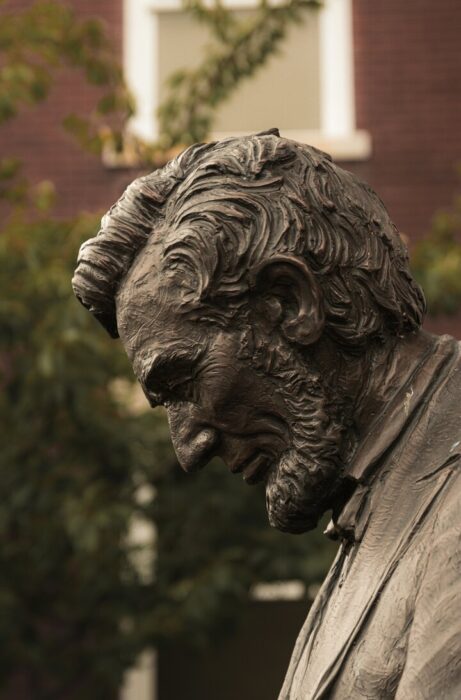
Picture: Missouri Civil War Museum, Worth Road, St. Louis, MO, USA (statue of Abraham Lincoln) by Kevin Wright.