




How press readers – citizens – engaged with war knowledge in the media in Australia during the First World War was investigated by Bart Ziino from Deakin University. In the article, there is the argument that citizens were capable of engaged and effective reading, allowing the citizens, in conjunction with their contacts, to achieve a genuine, if imperfect, understanding of the war.
There is a pervasive myth that the press had been integral in the deception of citizens by the state during the First World War, likening the masses to being “ignorant and innocent” in the words of the British politician Arthur Ponsonby. However, more recent scholarship has challenged this idea of willful distortion, and how citizens receive and understand information is a crucial area to investigate.
Australian diaries and correspondence formed the basis of this study and seeks to argue that the citizens did understand the war. Existing studies suggest that the Australian media presented an overly optimistic view of the war, and the distance allowed them to successfully fool the audience.
According to the author, the press was indeed full of speculation, rumour, trivia and repetition – but there was also much content that could be read effectively and sensitively. However, the reading of the wide context of the war was not an easy task. Nevertheless, Australians could at least gain an impression when the war was not going well as revealed in the writings of Arthur Hunter and John Gibson.
Even though maps and such were available, many Australian readers struggled with understanding the conflict due to their limited knowledge of Europe. Thus, the task of reading about the war was very much an active, challenging undertaking. The casualty lists made many readers apprehensive, again contradicting the narrative of the fooled, overly optimistic public.
From 1915 on, the media was able to offer soldiers’ letters to add a personalized touch to the news, which provided reassurance to friends and family back home, along with a more authoritative account of the war. The letters varied in tone greatly, and there appears to have mostly only been censorship of military information, not negativity.
Also, Australians were increasingly able to access multiple sources of information, as the soldiers’ correspondence widened the networks, as communities formed to share the experiences of sons and brothers fighting in the war. Sick and wounded soldiers also brought first-hand knowledge – leading some to understand the ghastliness of the war.
Even if 1914 to 1916 was characterized by hopes of a quick victory, the prognosis soon turned more cynical, even if battles such as Somme brought optimism, but also with them a dour sense of loss with the casualties. The Allied crises of 1917 were abundantly clear to the Australian readers.
Indeed, when the news of a massive German offensive in 1918 was released, the readers already had learned to suppress their optimism, and certainly were not blindly believing in victory despite the accusations of their peers. Even the end of the war in November 1918 hardly relieved the doubt and suspicion Australians had of wartime press.
The article “Reading, writing, rumour: press readership and the making of war knowledge in Australia 1914–1918” by Bart Ziino is in Media History. (Open access).
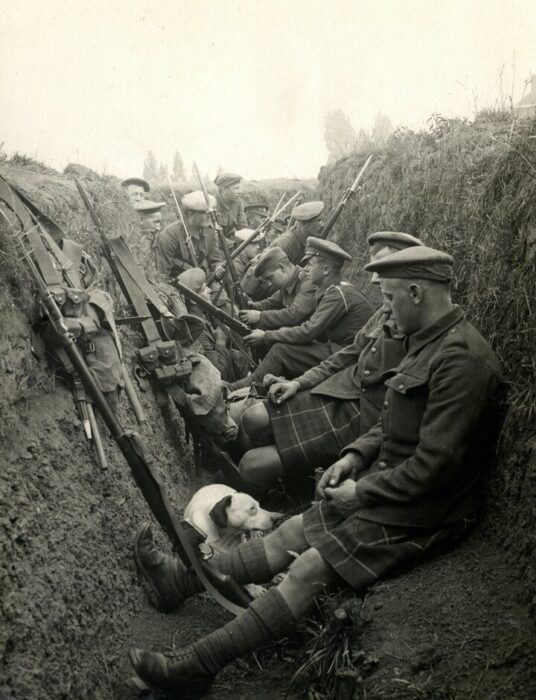
Picture: 1914, World War 1. Highland Territorials in a trench. Photographer: H. D. Girdwood. By British Library.
License Unsplash.