




A May article had media capture in Bangladesh as its topic, and the author of the article was Sima Bhowmik from University of Vermont. Particularly, the study examined journalists’ perceptions of media capture and its impact on journalism practice and media production by interviews with 25 Bangladeshi journalist participants.
Freedom of expression and democracy have declined in the past decades – a process described by scholars as a combination of democratic transition and authoritarian transformation, and seen as a threat to the press, or the fourth estate.
Bangladesh, along with North Korea and China, is one of the countries where a one-party regime or a dictatorship controls journalism and the public discourse. Here, the governments use media as a propaganda tool by controlling laws related to regulating the news content.
The concept of media capture, originating from economic scholarship, is defined by Andrea Prat (2015) as: “when the government has an active role: it uses threats and promises to suppress unfavorable information”.
Bangladesh, for media freedom, ranks 163/180 at the World Press Freedom. It is characterized as a “semi-authoritarian” country with a “dominant or one-party system”, where authoritarianism operates under the guise of democracy.
In-depth interviews were chosen as the method due to their ability to uncover complex processes, patterns, and behaviors. The names of the interviewees were not retained for their safety, but demographic information, professional role, and their media platforms were. Males outnumbered females by 20-5, and most had decent experience, with senior reporters outnumbering reporters, and there were 5 editors. The interviews were conducted in Bengali to ensure the richness of experience.
From 2009 to 2024, the country has been governed by the Awami League. Journalists critical of the government have often been subjected to violence or judicial harassment designed to silence them. The Cyber Security Law of 2023 was also cited as a reason why there is no press freedom in the country, as 87% of those arrested due to it are journalists.
The Act also made it possible for the government to target sources, making them reluctant to share information – with journalists often hiding their sources, which led to inquiries by the government. Authorities also have the power to revoke the rights of newsrooms critical of them. Online platform licensing was also controlled by the government.
Owners in the Bangladeshi media scene were typically large corporations aligned with major political parties, which significantly shapes news coverage in these organizations.
The interviewees saw three purposes for the ownership: protecting owners from competition, being a tool to criticize rivals, and securing closer relations with the government. Also, corruption was covered with the help of an owned media organization.
Social media platforms also have significant influence, and social media was a dominant tool in shaping audience attention. This led the journalists to produce content aligned with the algorithmic logics of the platform.
All these directly impacted journalism practice and media production. Journalists intentionally avoid writing critical stories or sidestep providing information, a type of self-censorship. Fear of the draconian law was also a commonly cited concern. Sometimes, the editors are the ones making the choice not to publish.
These fears led to the adoption of a “well-adjusted” approach, where the journalists seek to please both the owners and the government. For example, if a newspaper publishes a critical article of the government, it is typically followed by several positive ones. However, according to one interviewee, the defense sector was out of limits completely.
Audience and algorithms were a consideration, and by prioritizing the audiences and popular stories, the newsrooms ensured their own survival – relying heavily on Google and Facebook for (ad) revenue.
In conclusion, the external pressure on the newsrooms and journalists in Bangladesh also led to internalizing these pressures. The ownership structure reflects a politically aligned corporate capture, and the dependency on platforms added yet another layer to the media capture. The theoretical contribution on the scholarship of media capture was showing how capture in a hybrid system is a multi-actor process.
As suggestions to improve the situation, the author hopes for stronger legal protection of journalists and curbing of draconian laws, enforcing media ownership transparency, along with clear separation of editorial and business interests, addressing platform dependency, and strengthening professional training and internal networks.
The article “Capturing the fourth estate: A case study of Bangladesh news media” by Sima Bhowmik is in Journalism. (Open access).
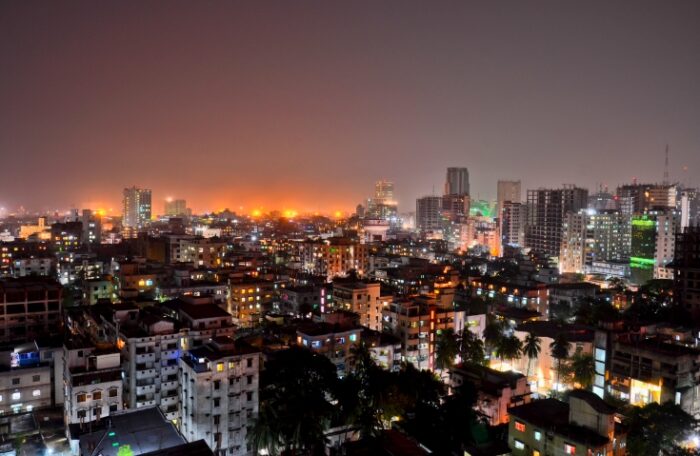
Picture: Dhaka skyline at night by Wikimedia commons.