




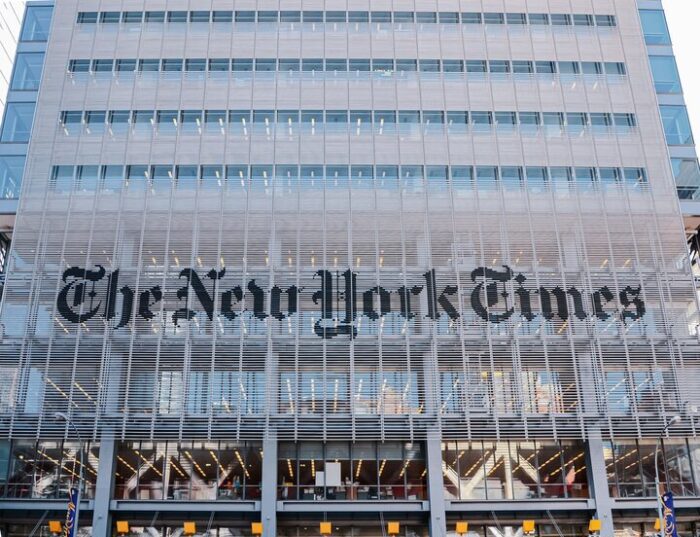
The October article by Benjamin Toff, Carolina Velloso, and Michael Ofori from University of Minnesota applied the concepts of “connection-based reporting” and “political identity ownership” to investigate the enhanced bios in the New York Times.
Prior studies have mainly focused on the effects of self-disclosure strategies on audience perceptions of trustworthiness (Johnson & St. John, 2021; Karlsson, 2020; Koliska, 2022; Masullo et al., 2022). Instead of that, this article focused on what sort of characteristics the New York Times journalists disclose about themselves.
Most of the disclosures focus on “safe” areas identity such as previous journalistic employment, awards, published books, and degrees from institutions – which are disproportionately from Ivy League schools. Few bios refer to personal identities or backgrounds.
A corpus of 1160 bios was analyzed. Most (N=883) included the staffer’s full name and photo, and most include a one-sentence description of the author’s identity and contact information. In the bios analyzed, 94% referred to gender and 80% to race. 53% were male, while 47% were female. For the racial breakdown, 80% were white, 14% Asian, 5% Hispanic, and 2% Black.
There was an overwhelming emphasis on professional and educational credentials with few references to other aspects of their identity. The most commonly mentioned other characteristics were marital and parental status, accounting for about 6% of the bios. Female staffers were more likely to refer to marital status, but men more likely to parental status, but the differences were not statistically significant.
References to race and ethnicity typically were accompanied by broader references about professional achievements, such as Michelle Agins describing herself as “the newspaper’s second Black female staff photographer”, or with references to their reporting like Matt Stevens “as a Korean adoptee, I have particular interest in Asian American stories.” Geographic places, such as where the staffer was born, were referenced in 43% of the cases. 45% were in the US and all but nine States were mentioned.
Professional credentials and educational backgrounds were frequently referred to. Even teaching experience was more frequently mentioned than marital status, and 25% mentioned a book they had written. Even more had college degrees (64%), and a decent amount graduate degrees (27%).
The authors ponder whether the limited emphasis on personal characteristics is a missed opportunity to build trust. While the focus on “safe” topics such as professional and educational achievements may build professional credibility and legitimacy within the profession, it is unclear whether this cultivates trust among the audiences.
Of course there were exceptions to what people chose to disclose. The authors see the topic as ripe for further research especially in the form of in-depth interviews to probe on the reasons for example, to omit community college background. They also suspect that one of the reasons to remind the readers of the humanity of their staffers for the New York Times is the proliferation of generative AI.
In conclusion, the authors state that the topic needs more study. They suspect that the limited references to race or LGBT status may be due to lack of diversity in the newsroom, not just a reluctance to foreground politically sensitive characteristics. Some also implicitly disclose an identity through photos, others do not – with white males more likely to include a photo.
The article “Bolstering trust by ‘letting them know who we are’: How New York Times ‘enhanced bios’ signal expertise” by Benjamin Toff, Carolina Velloso, and Michael Ofori is in Journalism. (Free abstract).
Picture: New York, Nueva York, EE. UU. by Rafael Hoyos Weht.
License Unsplash.